
A Precision Instrument You Can Wear Light
The Misura is the 4×5 large-format view camera in Arca-Swiss's F-Line that pushes "portability" to the extreme. It has been described in several places as one of the most compact and lightest monorail cameras on the market at the time, and in 2003 it won a Swiss Design Award — with the citation calling it exactly "a precision instrument you can wear light." The name Misura comes from Italian, meaning "measure / scale."
What it solves is large format's biggest pain point — bulk and weight. Traditional monorail cameras are precise and fully featured for movements, but big and unwieldy, a burden to carry out the door; wooden field cameras are light, yet often sacrifice precision and range of movement. The Misura wants both: to fold the precise geared movements of a monorail camera into a metal shell you can carry like a small shoulder bag.
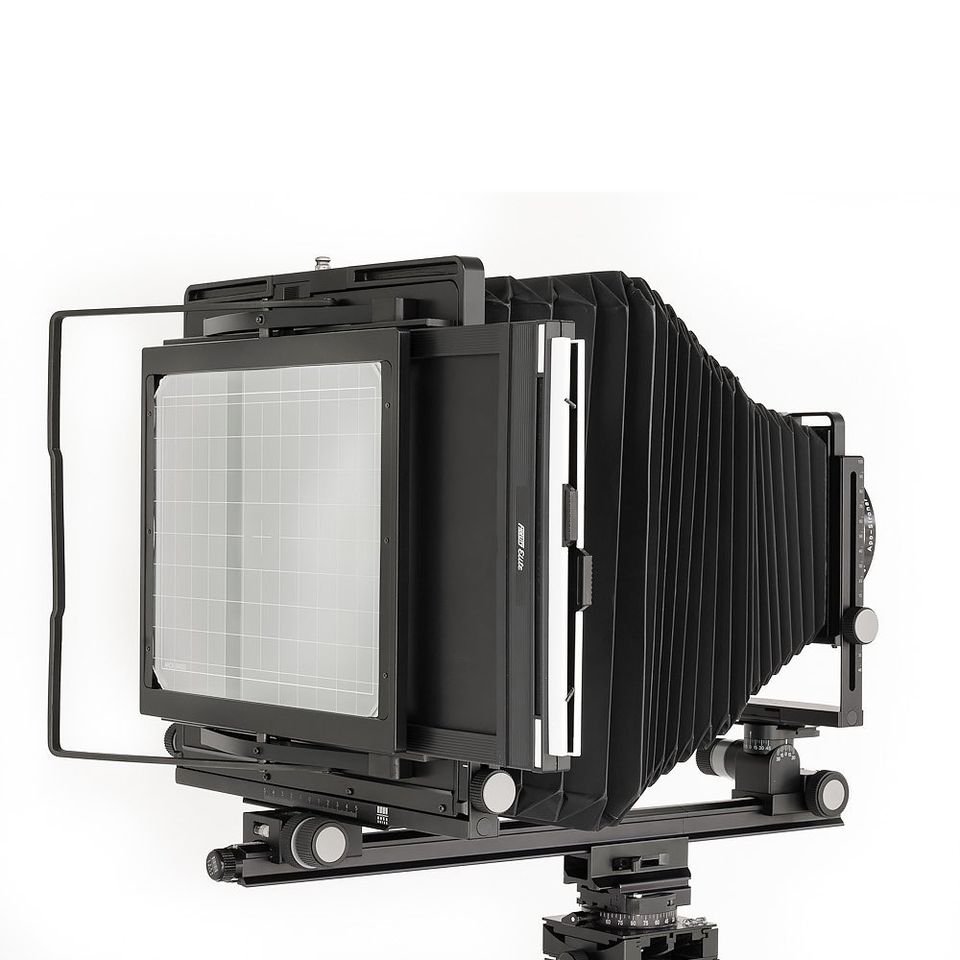
The Fold: Like a Beetle Spreading Its Wings
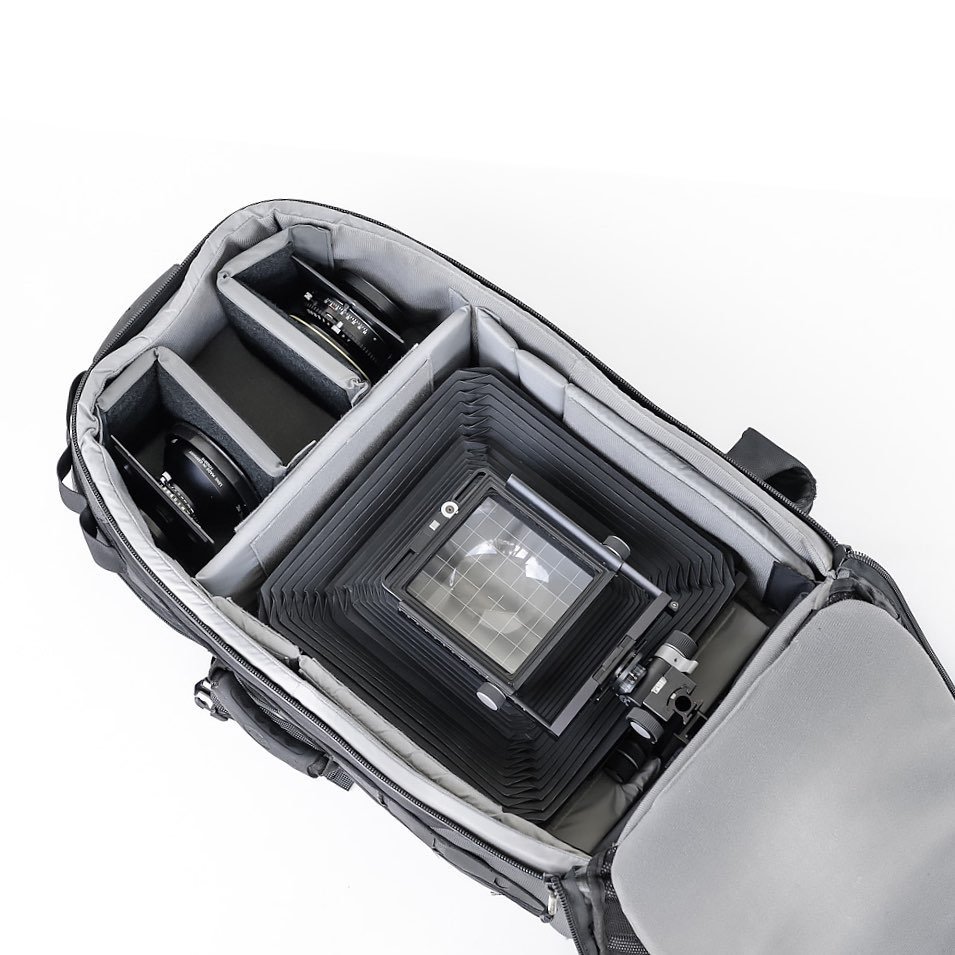
At heart it is a compact folding monorail, not a traditional wooden field camera. The core is a roughly 32cm folding monorail: the bellows and rail collapse together into the metal / leather shell, closing up into a neat box, then unfolding "like a beetle spreading its wings" to brace the front and rear standards into a camera.
The shell itself is the camera: the bottom of the body carries a standard Arca-type quick-release plate, so once unfolded it clamps straight into an Arca clamp on a tripod. The whole unit is mostly aluminum alloy / metal, and the shell comes in two versions, leather and metal.
Traditional large format forces a choice between "precise but heavy" and "light but crude"; what the Misura tries to do is fold it up — no loss of precision, half the bulk.
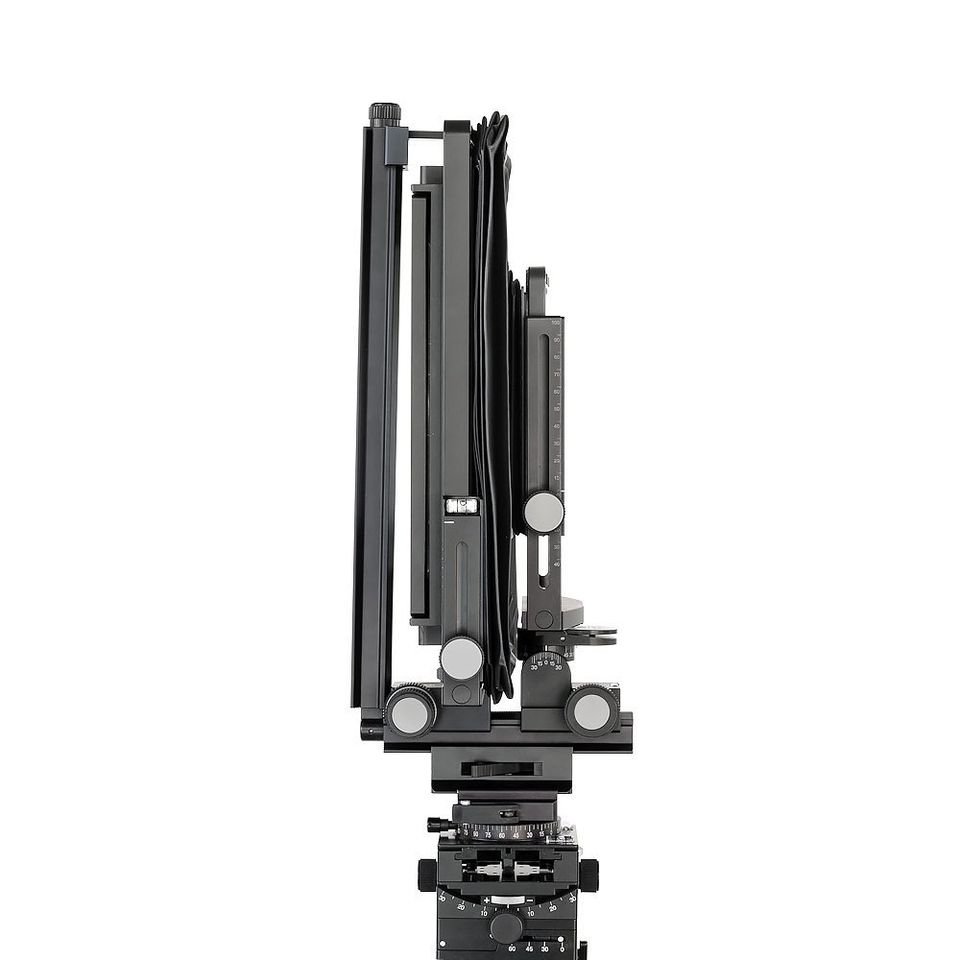
Movements & Focus: Geared + Orbix yaw-free
Geared focusing — both front and rear standards have precise geared focusing (right-hand operated), more accurate and finer to micro-adjust than the friction focusing of most wooden field cameras.
Full movements (4×5) — front rise 78mm, shift 70mm (rear shift 50mm); the front standard adds Orbix nodal-axis tilt (about +10° / −15° on top of base tilt), and the combination achieves complete yaw-free operation. Plenty for perspective correction and Scheimpflug in architecture and landscape work.
Specs at a Glance (Misura 4×5)
| Item | Misura 4×5 |
|---|---|
| Format | 4×5 (also 6×9 / 8×10 versions) |
| Type | Portable folding monorail, with metal / leather shell |
| Front rise | 78 mm rise |
| Shift | front 70 mm / rear 50 mm |
| Tilt | base tilt + front Orbix (approx. +10° / −15°), yaw-free |
| Focusing | front and rear precise geared focusing |
| Rail | approx. 32 cm folding monorail |
| Lens board | 110 × 110 mm |
| Weight | approx. 2.05 kg (without lens / film holder / base plate / shell) |
| Base | built-in Arca-type quick-release plate |
| Back | 4×5 sheet film + medium-format film / digital back (up to 6×9) |
Hands-On Workflow: Large Format in the Field, Traveling Light
Compatibility: Back / Lens / Shell
Back — primarily 4×5 sheet film; also takes medium-format film backs and medium-format digital backs (up to 6×9), with film / digital interchangeable.
Lens — mounted on a 110×110mm Arca lens board (not the 141mm large board), compatible with most large / medium-format lenses, paired with a Copal shutter; focal-length coverage depends on bellows configuration.
Shell & System — leather shell / metal shell, two options; as a member of the F-Line lineage, components such as standards, bellows and rails are interchangeable with the Arca-Swiss F system. What sets it apart from a regular F-Classic / F-Metric is its built-in protective shell + whole-camera folding storage, aimed at lightweight fieldwork rather than studio / general-purpose monorail use.
Working with the Misura in Optaxis
The greatest fear in large-format fieldwork is "getting to the location and finding you miscalculated." Optaxis helps you calculate first, then shoot:
Scheimpflug tilt calculation — enter the shooting distance and tilt angle, preview where the plane of focus lands, and judge how much tilt to give Orbix.
Movement coverage check — based on the image circle of the lens in use, verify whether 78mm front rise / 70mm shift still falls within the image circle with no corner vignetting.
Bellows factor compensation — for telephoto or close-up work with large bellows extension, Optaxis automatically factors in light falloff and corrects the exposure reading.
A 4×5 that folds into a shell to carry off — letting you bring large-format precision to places you'd previously only dare bring 135.